15 Days Kilimanjaro Machame Climb, Serengeti Safari, and Zanzibar is a 15 Days program that combines mountain trekking with a wider Tanzania journey. Instead of separating the climb from the rest of the trip, it folds the route into a single plan that moves from altitude and trail days into safari country or the coast in a practical order.
The mountain section is still the backbone of the itinerary. You trek with a dedicated crew, build altitude gradually, and follow the day-by-day route with the support structure needed for a strong climb or acclimatization-focused ascent on Kilimanjaro.
After the trekking stage, the itinerary broadens into Kilimanjaro, Tarangire, Serengeti, and Ngorongoro Crater. That gives the trip more range than a mountain-only program, with wildlife viewing, crater landscapes, or beach time depending on the exact route you are following.
This kind of combined itinerary works especially well for travelers making one major trip to Tanzania and wanting to use their time efficiently. It keeps the logistics connected, reduces repeated transfers, and turns the mountain climb into part of a fuller East African journey.
15 Days Kilimanjaro Machame Climb, Serengeti Safari, and Zanzibar leads you up the mountain stage by stage — each day a new altitude, a new ecological zone, and a measured step toward the summit.
-
1
Day 1: Arrival – Kilimanjaro Airport
Distance 55 km/miles,When you arrive, we’ll pick you up at the airport and take you to the pre-booked lodge/Hotel in Moshi, where you’ll spend the night. We will assemble that evening at 5:30 p.m.
to go through the pre-climb instructions and inspect our gear. Your overnight stay will include a half-board at the pre-booked Hotel for both dinner and breakfast.
Driving distance: 55 km/miles, Driving Time: 1 hour Hotel: Bed and Breakfast
-
2
Day 2: Machame Gate to Machame Hut
Altitude (1490m) to (2980m) Distance Approximately 18 kilometers Hiking 7 hours Habitat Montane forestWe will start our journey through the lovely and lush forest after completing the mandatory registration procedures at the Machame gate. We’ll stop for a picnic lunch along the way.
We will camp at Machame Hut Camp after the approximately five- to six-hour hike (9,800 ft). Elevation: (1490m) to (2980m) Hiking time: 7 hours Distance: Approximately 18 kilometers Habitat: Montane forest
-
3
Day 3: Machame Camp to Shira Camp
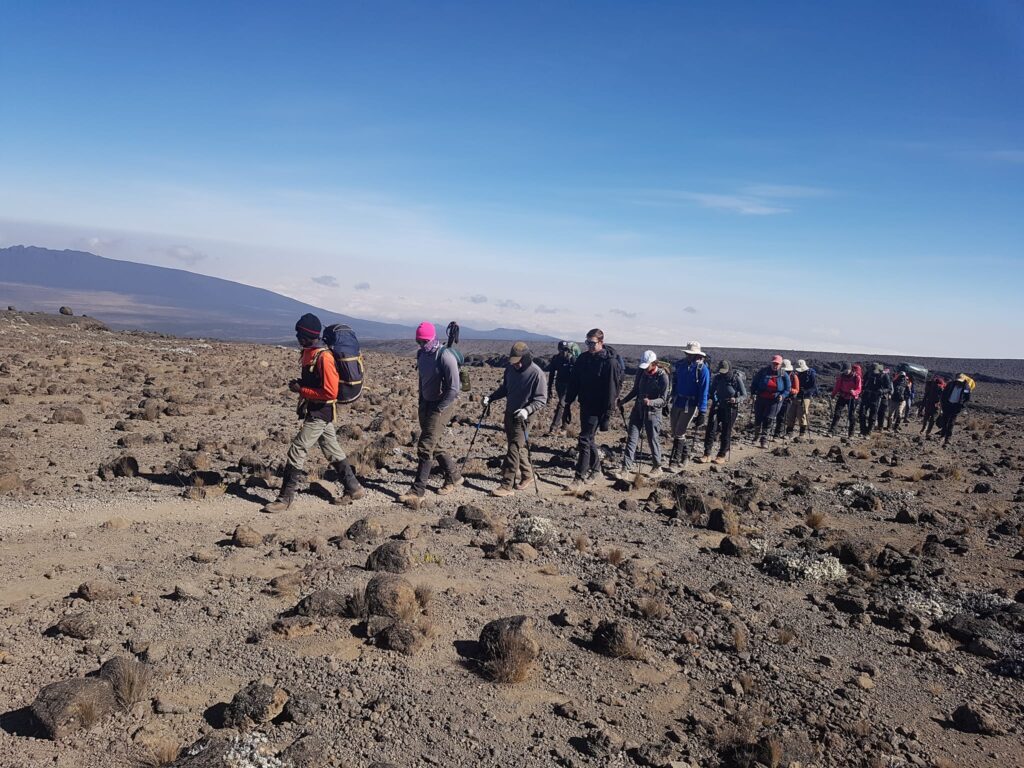
Distance Approximately 9 km Hiking 6 hours Habitat MoorlandAfter breakfast, we’ll leave the rainforest’s glades and climb up the mountain. We’ll hike over a narrow, rocky ridge covered with heather till it comes to an end when we cross the valley.
The path now takes a river valley to the west. The day will come to a conclusion with time for relaxation, dinner, and your stay the night at the Shira Campsite.
The journey today will be 5 kilometers long and take 4–6 hours. We’ll climb from 9,400 feet to 12,500 feet.
Hiking time: 6 hours Distance: Approximately 9 km Habitat: Moorland
-
4
Day 4: Shira Camp to Barranco Camp
Distance Approximately 15 km Hiking 7 hours Habitat Semi-desertThe trek today will be 10 kilometers and will take approximately 6–8 hours. From 12,500 feet to 13,000 feet, we will climb.
We proceed eastward from the Shira Plateau along a hill, past the intersection that leads to Kibo’s summit. As we go on, our course shifts to the southeast, in the direction of the “Shark’s Tooth” lava tower.
We’ll reach the second intersection, which leads us to the Arrow Glacier at a height of 16,000 feet, shortly after the tower. Moving on, we descend to the Barranco Hut Camp, which is 13,000 feet above sea level.
Here, we’ll take a nap, have dinner, and spend the night. Hiking time: 7 hours Distance: Approximately 15 km Habitat: Semi-desert
-
5
Day 5: Barranco Camp – Barafu Camp
Distance Approximately 13 km Hiking 7h Habitat Alpine desertAfter breakfast, we depart Barranco and make our way to the Karanga Valley Campsite through a narrow slope, crossing the Barranco Wall. After that, we’ll depart Karanga and arrive at the intersection of the Mweka Trail.
Onward to Barafu Hut, we go. You have now finished the South Circuit, which provides a variety of perspectives from the top.
We’ll set up camp here, have a nap, eat dinner, and get ready for the summit day. From here, one can view Mawenzi and Kibo, the two summits.
This 9km trek, which rises from 13,000 to 15,000 feet, will take 8 to 10 hours. Hiking time: 7h Distance: Approximately 13 km Habitat: Alpine desert
-
6
Day 6: Barafu Camp to Summit down Mweka Camp
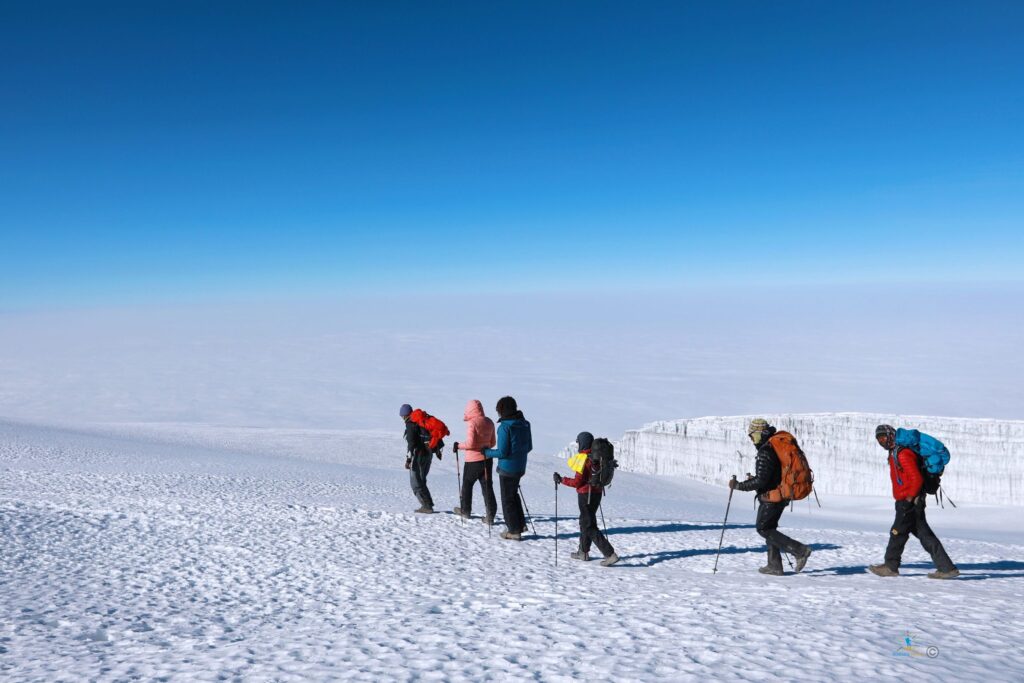
Distance Approximately 7 km ascent – 23 km descent Hiking 8h to reach Uhuru Peak, 7 – 8h to descend to Mweka Habitat Stone scree and ice-capped summitWe’ll continue climbing to the peak between the Rebmann and Ratzel glaciers quite early in the morning (between midnight and two in the morning). You’ll travel northwest and climb across steep scree in the direction of Stella Point on the crater rim.
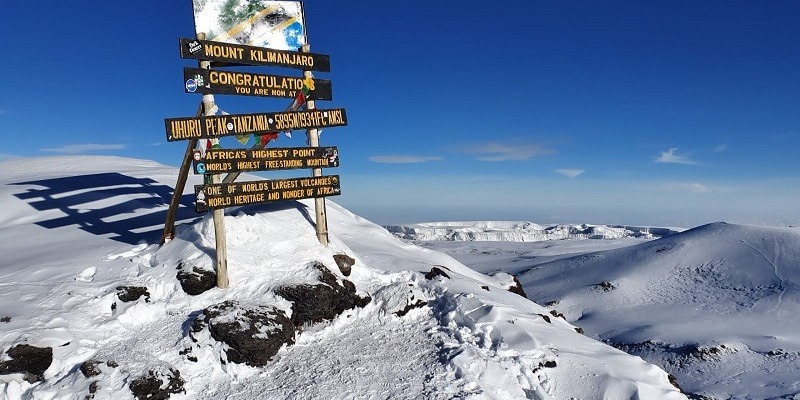
The hardest part of the walk both physically and emotionally is this section. You will take a brief break at Stella Point (18,600 feet), where you will be rewarded with the most spectacular dawn you are ever likely to witness (if the weather permits).
On your hour-long journey to the peak from Stella Point, you could run into the snow the entire way. You will have reached Uhuru Peak, the highest peak on Mount Kilimanjaro and the African continent.
The dawn may be seen from the peak by more quick hikers. We now begin our descent from the peak, going straight down to the Mweka Hut Campsite while pausing at Barafu for lunch.
We’ll have our final meal on the mountain later in the evening before a well-deserved rest. Hiking time: 8h to reach Uhuru Peak, 7 – 8h to descend to Mweka Distance: Approximately 7 km ascent – 23 km descent Habitat: Stone scree and ice-capped summit
-
7
Day 7: Mweka Camp – Gate Out
Distance Approximately 15 km Hiking 3h Habitat ForestThrough a wonderful tropical forest alive with bird song and boasting rich undergrowth with significant botanical interest, we descend steadily on a well-built trail. Our path descends steeply to the Mweka (5,400 ft) gate of the Kilimanjaro National Park before continuing through coffee and banana plantations to the villages of Mweka.
We will then be driven to our accommodation in Arusha from here. [4-6 walking hours].
Hiking time: 3h Distance: Approximately 15 km Habitat: Forest
-
8
Day 8: Arusha – Lake Manyara National Park
You will be picked up from your accommodation in Arusha and taken on a wildlife drive across the East African Great Rift Valley’s Lake Manyara National Park. The park’s northern region is covered in thick forest, but as you travel south, the environment gets dryer.
In this park, you may expect to witness elephants, buffalo, giraffes, herds of baboons, impalas, and occasionally even lions who have taken to sleeping in trees to avoid the bothersome flies. While hippos attempt to cool down in the water from the heat of the sun, a large number of flamingos forage around the edges of the shallow soda lake.
After the wildlife drive concludes just before dusk, your driver will bring you up to the Ngorongoro Crater Highlands over winding, steep roads. You’ll get to take in some breathtaking views of the park and the lake below.
Dinner and overnight at Migombani Campsite
-
9
Day 9-10: Lake Manyara National Park – Serengeti National Park
Before descending onto the short-grass plains of the Serengeti, the picturesque route to Serengeti National Park travels through the spectacular montane forest around the rim of Ngorongoro Crater. Fantastic views of the Ngorongoro crater, a few large extinct volcanoes, and the huge plains can be seen along the trip.
The immense expanses of the Serengeti National Park will be explored over the course of two days. For grazers, the Serengeti is a utopia.
On their yearly migration, hundreds of thousands of wildebeest and other species like zebras and Thompson gazelles move through this distinctive ecosystem, constantly trailed by lions and hyenas seeking food. You are most likely to see elephants, buffalo, giraffes, ostriches, and a variety of other animals and bird species while on a game drive in Serengeti National Park.
If you’re lucky, you could spot a leopard taking a nap in a tree or a cheetah hunting. All meals are served in Mbugani Camp, your semi-luxury camp.
-
10
Day 11: Serengeti National Park – Ngorongoro Crater
After breakfast this morning, you’ll drive to Ngorongoro. In the Ngorongoro Crater, a UNESCO World Heritage Site, you will then descend for a fantastic wildlife drive (with a picnic lunch).
The Ngorongoro Crater boasts the largest wild animal population on earth because so few animals travel in and out of the crater’s 2000-foot high walls. Lions, elephants, giraffes, zebras, hippos, flamingos, jackals, rhinoceroses, lions, and many other animals are among the species.
The “Big Five” may be expected to be seen in a single day. You will have dinner and spend the night at Farms of Dream Lodge.
-
11
Day 12: Ngorongoro Crater – Arusha – Zanzibar
We go to Arusha town after an early breakfast. You’ll depart for Zanzibar in the middle of the morning.
Your local representative will welcome you when you arrive in Zanzibar. After being driven to your accommodation, you will settle in and then start the Stone Town tour.
As you explore the beauties of this ancient city, which has managed to preserve much of its original character while still accepting modernization’s components warmly, albeit warily, your Stone Town tour of Zanzibar will be filled with several moments of awe. Every detail of its rich history is seen in the stunning structures, some of which hint at the arrival of the Omanis in Zanzibar and others that speak of the roots of Swahili architecture combined with a Persian Shirazi influence.
Numerous domestic homes with authentic Swahili-Omani design elements adorn the small streets. You will spend the night at the Tausi Palace hotel.
-
12
Day 13-14: Beach at Leisure in Kendwa Rocks
This beachfront hotel has options for every requirement and price range. In little time at all, the tranquil environment of Zanzibar will calm you down.
From Zanzibar Town, Kendwa Rocks is located in the northernmost part of the island, about an hour’s drive away. The road falls to one of East Africa’s most stunning beaches.
Sunbathing could be sufficient, but you can also go diving, fishing, snorkeling, and taking leisurely small boat rides in the clear seas. Moonlit nights on the white coral and seashell beach provide a memorable experience, and stunning sunsets are a daily pleasure.
There are several options for lodging. Choose between a family room, a large suite, a wooden bungalow with a jacuzzi, or a coral stone cottage.
Coconut palms and lovely tropical gardens around the apartments.
-
13
Day 15: Zanzibar
The morning is yours to spend at the beach. We will set up the transfer in accordance with your departure flight from Zanzibar Airport.
Your departure flight will be dropped off at the airport by our local agent.
All prices are per person. Final rates vary with route length, group size, and any safari or hotel extensions you add before or after the climb.
- – All park, conservation, camping, and rescue fees required for the route
- – Professional mountain guide, assistant guides, cook, and porter support
- – Private transfers between your hotel and the trek gate as listed in the itinerary
- – All meals on the mountain plus safe drinking water during the climb
- – Mountain tents, dining tent, table, chairs, and standard camping equipment
- – Emergency oxygen, basic first-aid kit, and daily health monitoring on the mountain
- – Safari game drives, park entry fees, and accommodation for the wildlife section listed in the itinerary
- – Mainland and island accommodation included where shown in the combined itinerary
Are You Ready for the Climb?
This 15 days reaches high altitude and should be approached with steady pacing, hydration, and realistic fitness preparation. The route climbs to 5,895 m · Uhuru Peak, so altitude response matters more than speed. A longer, calmer ascent usually improves comfort and summit chances, especially when you listen closely to your mountain crew and allow time for acclimatization. Trekkers do not need technical climbing skills for Kilimanjaro, but they do need endurance for long walking days and summit night effort.
Recommended Gear Checklist
- Waterproof hiking boots · Essential
- Layered warm clothing for summit night · Essential
- Waterproof jacket and rain trousers · Essential
- Daypack and duffel bag · Essential
- Headlamp with spare batteries · Essential
- Sun hat, sunglasses, and sunscreen · Essential
- Trekking poles
- Refillable water bottles or hydration bladder · Essential
-
How difficult is the Machame?
This route is best described as challenging. The main challenge is sustained trekking at altitude rather than technical climbing.
-
How many days should I allow for this trek?
This itinerary is planned over 15 Days, giving a clear stage-by-stage progression through the mountain route shown in the itinerary.
-
Do I sleep in huts or tents on this route?
This route uses mountain huts according to the imported itinerary and overnight camp references.
-
When is the best season to climb?
The usual best climbing windows are Jan–Mar, Jun–Oct, when trail conditions are generally more favorable and mountain visibility is often better.
-
What helps summit success on this route?
This route is known for high on the longer itinerary. The biggest factors remain pacing, hydration, rest, and allowing the body time to adapt to altitude.
Photo gallery will be added soon.